
A Week-by-Week Timeline
A deep plane facelift is a surgical procedure that repositions facial tissues to improve the contours of the face and neck. Although the technique is designed to create natural-looking rejuvenation, recovery still involves a somewhat lengthy period of swelling, bruising, and tightness. The early post-operative period looks quite different from the eventual result. So, patients should expect the appearance of their face to change substantially over the first several weeks. Although recovery timelines can provide a helpful framework, they should not be interpreted as a guarantee of what any individual patient will experience.
The First 24 to 72 Hours
The first few days after a deep plane facelift are generally focused on rest and monitoring the surgical sites. Patients will have a dressing or compression bandage and temporary drains. Swelling and bruising are to be expected, and the face may feel sore, tight, or unusually firm. Some patients also experience temporary numbness or altered sensation. Keeping the head elevated while resting and following Dr. Russell’s post-op care instructions help support the early stages of recovery.
A follow-up appointment is scheduled for the day after surgery. During the visit, Dr. Russell will assess the incisions, swelling, bruising, and remove the drains or dressings. Then he will review the care instructions. Protecting the incisions is particularly important during this period. Patients should follow the specific instructions about cleansing, showering, ointments, dressings, and medications, rather than applying products that have not been recommended.
The First Week
During the remainder of the first week, swelling and bruising may still be quite noticeable. Bruising and swelling often reach their peak around the 3rd or 4th day before gradually improving. Incisions might appear pink or red, swollen, or somewhat uneven. Although, in some patients, this may vary. As the initial discomfort decreases, patients may find it easier to move around the house and perform light activities. Walking may also be encouraged, but strenuous activities should be avoided during the early healing period.
Sutures are removed in three stages over the first two weeks, as different areas along the incision lines heal at different rates. The first set are typically removed 5 days after surgery, the second set at 7-8 days after surgery, and the last set at 11-12 days after surgery. Patients should avoid rubbing, scratching, or placing unnecessary pressure on healing incisions. Follow-up visits allow Dr. Russell to monitor the surgical sites and make sure that healing is progressing appropriately.
Weeks 2 and 3
By the second and third weeks, many patients notice a meaningful reduction in bruising and swelling, although the face may still look fuller than expected. Tightness, numbness, tingling, or areas of altered sensation can persist as the tissues and sensory nerves recover. The facial contours generally become easier to appreciate as post-operative swelling decreases, but this is still an intermediate stage, rather than the finished result.
Most patients feel comfortable returning to work and light social activities during this period, while others prefer additional time at home. After undergoing a more extensive facelift, returning to work takes roughly 2 to 3 weeks, but the appropriate timing depends on the nature of the job and the individual’s healing progress. Strenuous exercise and other physically demanding activities should still be put on hold until their surgeon gives them clearance.
Returning to Work and Social Activities
The timing of a return to work depends partly on how visible the remaining swelling and bruising are, and partly on the physical demands of the job. Someone working remotely may feel ready to work sooner than someone whose job involves frequent public interaction, physical exertion, or prolonged periods of bending and lifting. As a general guideline, most facelift patients feel comfortable returning to work and social engagements at the two-week mark after surgery. But of course, individual experiences differ; some need less time, and some need more time.
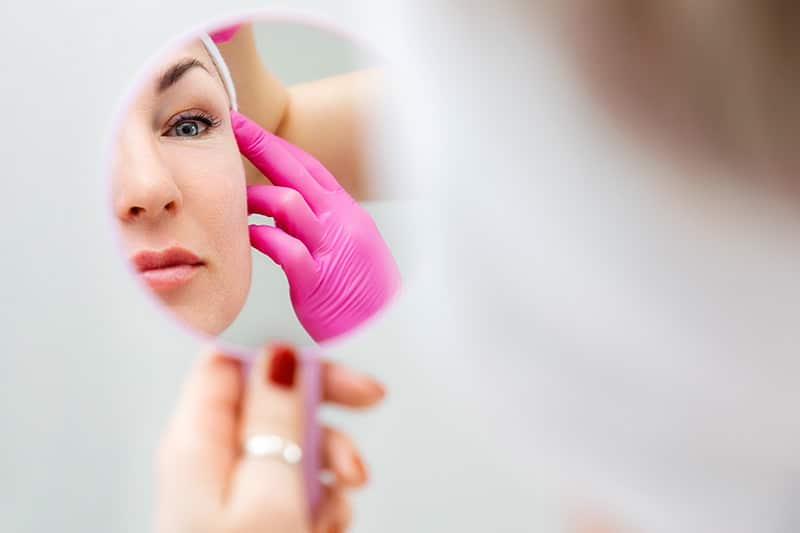
Social activities can also be resumed gradually as a patient becomes comfortable. By this point, makeup can help camouflage residual bruising, provided Dr. Russell has confirmed that the incisions have healed sufficiently for cosmetic products. Patients should continue protecting their treatment sites from excessive sun exposure and follow Dr. Russell’s instructions about hair washing, various facial products, and other activities that could irritate the healing incisions.
Residual Swelling and Tightness
One of the most important things to understand about deep plane facelift recovery is that visible improvement does not mean the healing is complete. Even after most bruising has faded, patients may notice residual swelling, firmness, tightness, numbness, or changes in sensation.
Residual swelling generally continues to decrease over the following weeks and months. The face may appear slightly different from one side to the other while swelling resolves, and temporary firmness or unevenness does not necessarily represent the final outcome. Patients should resist the temptation to judge the result too early and instead attend scheduled follow-up appointments, so that Dr. Russell can monitor the overall process.
When Results Begin to Look Natural
As the first several weeks pass, the effects of the facelift become increasingly apparent. The cheeks, jawline, and neck will begin to look more defined as swelling subsides and the skin and deeper tissues gradually settle into their new position. For many patients, their appearance becomes more and more natural-looking during the first several weeks, but the pace of change varies among individuals.
Importantly, a facelift is not intended to produce an immediate “finished” appearance. Early postoperative swelling can temporarily obscure contours or make the face look fuller or tighter than expected. The goal is to allow the tissues to heal and settle, rather than trying to accelerate the process. The patient’s surgeon is in the best position to determine whether a particular change is part of normal healing or should be further evaluated.
When the Final Result Becomes More Apparent
By approximately two to three months, swelling will have subsided, and the overall facial contours can be appreciated. However, smaller amounts of swelling and tightness can persist beyond this point. It can take several months for swelling to fully dissipate and for incision lines to mature.
For that reason, the “final result” is better understood as a gradual progression rather than a specific date on the calendar. Some patients may feel that their result looks settled relatively early, while subtle changes can continue for many months. Rather than focusing on a single milestone, patients should evaluate their progress over time and maintain regular postoperative follow-ups with Dr. Russell.
Why Recovery Differs Among Patients
There is no single deep plane facelift recovery timeline that applies to everyone. Recovery can be influenced by numerous factors, such as:
- The extent of surgery
- Prior surgery, fillers, or other treatments to the face
- Whether a neck lift or other procedures were performed at the same time
- Individual anatomy
- Skin characteristics
- Age
- Overall health
- Medications
- An individual’s natural healing response
Surgical technique and postoperative care protocols also vary among surgeons. Even patients who undergo similar procedures may have different recovery experiences.
Therefore, the best approach is to use this recovery timeline as a general guide, rather than a promise. Following Dr. Russell’s instructions, attending scheduled appointments, and protecting the surgical sites will help support recovery. Patients should also contact their surgical team if they develop unexpected symptoms or have concerns, rather than assuming that every change is a normal part of healing.